Kava vs Kratom: Differences, Effects & Legality
In this article

Kava and Kratom are different botanicals that come from separate plants, contain different natural compounds, and have distinct traditional uses. The main difference between “Kava vs Kratom” is that Kava comes from the root of the Piper methysticum plant and contains Kavalactones, while Kratom comes from the leaves of the Mitragyna speciosa tree and contains naturally occurring alkaloids such as Mitragynine. Although they are often compared because both are plant-based ingredients found in teas, extracts, and modern botanical beverages, they are not the same.
Each has a unique background, preparation method, and place within the growing functional beverage market, including alcohol alternatives, ready-to-drink products, and social relaxation drinks.
In this guide, we’ll explore the differences between Kava and Kratom, how they compare as beverage ingredients, their common formats, taste profiles, and legality.
Kava vs Kratom: Key Takeaways
|
Feature |
Kava |
Kratom |
|
What it is |
A botanical made from the root of the Piper methysticum plant |
A botanical made from the leaves of the Mitragyna speciosa tree |
|
Native origin |
South Pacific islands |
Southeast Asia |
|
Plant Family |
Pepper family |
Coffee family |
|
Plant part used |
Root and rhizome |
Leaf |
|
Main natural compounds |
Kavalactones |
Alkaloids, including mitragynine |
|
Traditional use |
Social and ceremonial beverages in Pacific Island cultures |
Traditional leaf preparations and beverages in parts of Southeast Asia |
|
Common modern formats |
Kava beverages, sparkling Kava drinks, extracts, non-alcoholic social drinks |
Kratom beverages, drink mixes, seltzers, shots, and extracts |
|
Taste profile |
Earthy, woody, and traditionally peppery; modern drinks may use flavors to balance the profile |
Earthy and grassy, flavored beverages may use fruit notes and sweeteners |
|
Legality |
Generally available, but product regulations may vary |
Legal status varies by state and local jurisdiction in the U.S. |
|
Key difference |
Comes from a root and contains Kavalactones |
Comes from a leaf and contains mitragynine and other alkaloids |
What Is Kava?
Kava is a botanical made from the roots and underground stems of the Piper methysticum plant, a species native to the Pacific Islands. It has a long history of traditional use in cultures across regions such as Fiji, Vanuatu, and other Pacific Island communities.
Quick Facts About Kava
|
Category |
Details |
|
Botanical name |
|
|
Plant family |
Pepper family (Piperaceae) |
|
Plant part used |
Root and underground stems |
|
Native region |
South Pacific Islands |
|
Main active compounds |
Kavalactones |
|
Traditional preparation |
Root processed and mixed with water |
What Are Kavalactones?
As per a ScienceDirect study, Kavalactones are naturally occurring compounds found in Kava root. Different Kava varieties can contain different levels and combinations of these compounds, which contribute to the plant’s unique chemical profile.
How Is Kava Traditionally Used?
Traditionally, Kava has been prepared as a beverage by:
- Grinding or crushing the dried root
- Mixing it with water
- Straining the mixture before consumption
It has historically been used during social gatherings, ceremonies, and cultural events throughout the Pacific Islands.
Common Kava Forms
Today, Kava is available in several forms, including:
- Traditional root preparations
- Powdered Kava root
- Instant Kava products
- Kava extracts
- Ready-to-mix beverages
While modern products may vary in preparation and concentration, they are all derived from the same botanical source: Piper methysticum.
What Is Kratom?
According to an article in ACS Publications, Kratom is a botanical derived from the leaves of the Mitragyna speciosa tree, a tropical evergreen plant native to Southeast Asia. Unlike Kava, which comes from a root, Kratom comes from the leaves of the plant and has traditionally been prepared in Thailand, Malaysia, and Indonesia.
Quick Facts About Kratom
|
Category |
Details |
|
Botanical name |
|
|
Plant family |
Coffee family (Rubiaceae) |
|
Plant part used |
Leaves |
|
Native region |
Southeast Asia |
|
Main natural compounds |
Mitragynine and other alkaloids |
|
Traditional preparation |
Fresh leaves chewed or brewed into tea |
What Are Kratom Alkaloids?
Kratom leaves contain naturally occurring alkaloids, with mitragynine being the most abundant and widely recognized compound. The alkaloid composition can vary depending on factors such as the plant source, growing conditions, and processing methods.
Unlike standardized single-compound products, traditional Kratom leaf products contain a naturally occurring combination of plant compounds.
How Is Kratom Traditionally Used?
Historically, Kratom leaves have been prepared in Southeast Asian communities through methods such as:
- Chewing fresh leaves
- Brewing leaves into tea
- Preparing traditional leaf-based drinks
The preparation method and cultural practices surrounding Kratom have varied across different regions.
Common Kratom Forms
Modern Kratom products are available in formats such as:
- Dried Kratom leaves
- Kratom powder
- Kratom capsules
- Kratom extracts
- Kratom tea and drink products
While these formats differ in preparation and processing, they are all derived from the leaves of Mitragyna speciosa.
Kava vs Kratom: 5 Main Differences
Although Kava and Kratom are often compared because both are plant-based botanicals, they come from different plants and have distinct origins, compounds, and traditional uses. Understanding these key differences makes it easier to see why they are not interchangeable.
1. Plant Source: Kava Root vs Kratom Leaf
The biggest difference between Kava and Kratom is the part of the plant used.
|
Differences |
Kava |
Kratom |
|
Plant source |
Piper methysticum |
Mitragyna speciosa |
|
Plant family |
Pepper family (Piperaceae) |
Coffee family (Rubiaceae) |
|
Part used |
Root and underground stems |
Leaves |
Kava is made from the roots of the Kava plant, while Kratom products are made from the leaves.
2. Geographic Origin and Traditional Background
Kava and Kratom come from different parts of the world and have separate cultural histories.
Kava:
- Originates from the Pacific Islands
- Traditionally prepared as a communal beverage
- Used during ceremonies, social gatherings, and cultural events
Kratom:
- Originates from Southeast Asia
- Traditionally used in countries such as Thailand, Malaysia, and Indonesia
- Historically prepared using fresh leaves or brewed leaf-based drinks
3. Natural Compounds: Kavalactones vs Mitragynine
Kava and Kratom contain different naturally occurring compounds.
Kava contains:
-
Kavalactones, a group of compounds naturally found in Kava root
Kratom contains:
-
Alkaloids, including Mitragynine and other naturally occurring plant compounds
These differences in botanical composition are one of the main reasons Kava and Kratom have distinct profiles.
4. Traditional Preparation Methods
The way these botanicals have traditionally been prepared is also different.
Traditional Kava preparation:
- Kava root is processed into a powder or pulp
- Mixed with water
- Strained before serving
Traditional Kratom preparation:
- Fresh leaves may be chewed
- Leaves may be brewed into tea
- Leaf preparations may vary by region
5. Legal Status and Regulation
The legal landscape is another important difference between Kava and Kratom.
- Kava: Generally available in many countries, although regulations around supplements and food products may vary.
- Kratom: Legal status varies more significantly, especially in the United States, where regulations differ by state and locality.
Consumers should always check current local laws before purchasing or traveling with Kratom products.
Kava vs Kratom Effects: How Do Their Profiles Compare?
Kava and Kratom do not produce identical effects. Kava is more commonly associated with a calming and socially relaxed profile, while Kratom’s reported effects can vary more widely depending on the product, alkaloid concentration, and individual response.
Kava Is Commonly Associated With Relaxation
Kava’s profile comes primarily from Kavalactones, the naturally occurring compounds found in its roots.
People commonly describe Kava as producing:
- A calm or settled feeling
- Physical relaxation
- A more relaxed social experience
- Temporary tingling or numbness in the mouth
The overall experience may differ based on the Kava variety, preparation method, and Kavalactone concentration. Research into Kava has primarily examined its potential effects on anxiety, but evidence remains limited, and safety considerations still apply.
For a broader look at the potential Kava benefits, see our detailed guide.
Kratom May Have a More Variable Profile
Kratom contains naturally occurring alkaloids, with mitragynine being the most prominent. Its reported profile is less consistent than Kava’s and may vary according to:
- The type of Kratom product
- Alkaloid concentration
- Whether it contains leaf material or an extract
- Product formulation
- Individual response
According to one ScienceDirect research, Kratom has been reported to produce both stimulant-like and sedative-like effects. However, these effects should not be treated as predictable or guaranteed, particularly because commercial products can differ significantly in composition.
Important: Experiences with either botanical can vary. Neither Kava nor Kratom should be presented as producing guaranteed effects, and concentrated products should not be assumed to have the same profile as traditional plant preparations.
Kava And Kratom In Modern Botanical Beverages
Both Kava and Kratom are now available in convenient drink formats beyond their traditional preparations, becoming part of the broader types of functional beverages available today.
Common options include:
- Ready-to-drink cans
- Flavored botanical beverages
- Drink mixes
- Sparkling drinks
- Extract-based shots
However, Kava and Kratom beverages are not interchangeable. Kava drinks contain compounds called Kavalactones, while Kratom drinks contain alkaloids such as mitragynine. Their concentration and formulation can also differ from one product to another.
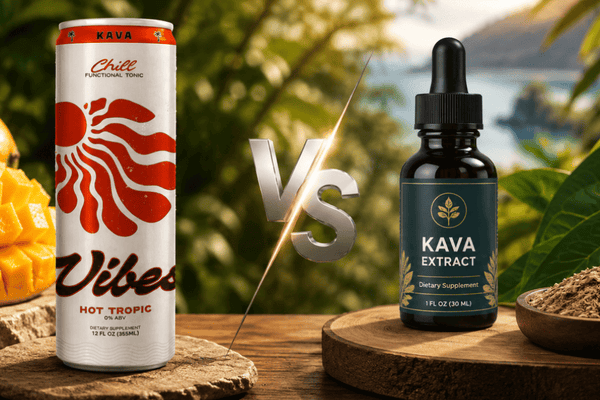
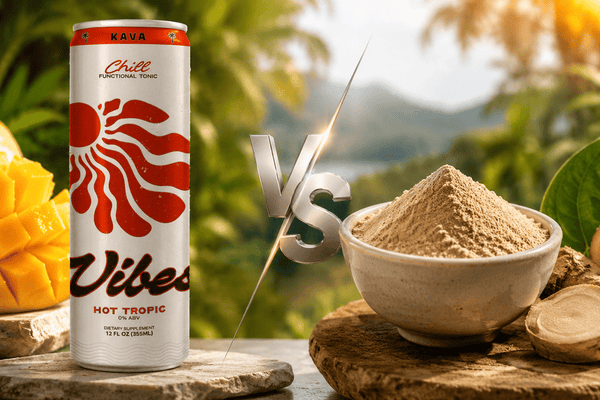
For example, Vibes Chill – Hot Tropic Kava is a ready-to-drink product made with Kava root extract and 60 mg of kavalactones per can. It combines a tropical mango flavor with ingredients such as L-theanine, green tea extract, and Alpha-GPC. This illustrates how modern products may place traditional Kava compounds into a flavored, pre-formulated beverage rather than using the customary root-and-water preparation.
FAQs
Do Kava And Kratom Come From The Same Plant?
No. Kava comes from the roots of Piper methysticum, a plant in the pepper family. Kratom comes from the leaves of Mitragyna speciosa, a tropical tree in the coffee family. They are botanically distinct and contain different natural compounds.
Is Kava Stronger Than Kratom?
Neither Kava nor Kratom is universally stronger because they contain different active compounds and produce different reported profiles.
Is Kava Safer Than Kratom?
Neither Kava nor Kratom can be considered universally safer. The National Center for Complementary and Integrative Health (NCCIH) fact sheet states that Kava products have been associated with rare but potentially serious liver injury, while Kratom has been linked to dependence, withdrawal, and other adverse effects.
Safety also depends on product quality, concentration, and individual factors.
Which Is More Relaxing, Kava Or Kratom?
Kava is more consistently associated with a calming and relaxation-focused profile. Kratom’s reported profile is more variable and may differ according to alkaloid concentration, formulation, and individual response. Neither botanical should be expected to produce guaranteed effects.
Does Kava Show Up On Drug Tests?
Kava is not typically included in standard workplace drug-test panels. However, testing policies and methods vary, and specialized tests may detect specific compounds. Kavain has also been reported to interfere with some Initial Amphetamine Immunoassays, making confirmatory testing important.
Does Kava Feel The Same As Kratom?
No. Kava and Kratom contain different compounds and do not have identical profiles. Kava is generally associated with relaxation, whereas Kratom has been reported to produce stimulant-like or sedative-like effects (DEA), depending on the product and other factors.
Is Kava Addictive Like Kratom?
Kava and Kratom do not have the same dependence profile. According to the National Institute on Drug Abuse, regular Kratom use can lead to dependence and withdrawal in some people. Kava is not known for the same opioid-receptor activity, but frequent use should not automatically be considered risk-free.
Are Kava And Kratom Legal?
Kava is generally available in the United States, although food and product regulations still apply.
According to LAPPA's state-by-state analysis, Kratom is not federally scheduled under the Controlled Substances Act, but its legal status varies by state and locality. Some jurisdictions prohibit it, while others regulate matters such as age limits, labeling, or product composition.
Read our blog, “Is Kava Legal?,” to learn about its legality in detail.
Can You Mix Kava And Kratom?
Mixing Kava and Kratom is not recommended without guidance from a qualified healthcare professional. One short-term study in healthy adults found that a specific commercial liquid blend containing both botanicals was generally well tolerated at the tested amounts. However, the findings apply only to that formulation and study period, so they should not be taken as proof that every Kava–Kratom combination is safe.
Consult a qualified healthcare professional before combining them, especially if you take medication, use alcohol, or have an existing health condition.
Which Lasts Longer: Kava Or Kratom?
Kratom is often reported to last longer than Kava, but duration varies widely by product, concentration, and individual response.
Learn the answer to “How Long Does Kava Last?” with our detailed guide.
Disclaimer: This content is for informational purposes only and is not medical or legal advice. Effects, product quality, and laws may vary. Consult a qualified professional and check current local regulations before use.
Bibliography
-
American Chemical Society. (2020). Kratom alkaloids: Interactions with receptors and implications for therapeutic applications. Journal of Natural Products. https://pubs.acs.org/doi/10.1021/acs.jnatprod.0c00257
-
Drug Enforcement Administration. (2020). Kratom (Mitragyna speciosa): Drug & Chemical Evaluation Section. https://www.dea.gov/sites/default/files/2020-06/Kratom-2020_0.pdf
-
Legislative Analysis and Public Policy Association. Kratom: Summary of State Laws. https://legislativeanalysis.org/kratom-summary-of-state-laws/
-
National Center for Complementary and Integrative Health. Kava. https://www.nccih.nih.gov/health/kava
-
National Institute on Drug Abuse. Kratom. https://nida.nih.gov/research-topics/kratom
-
PubMed. (2015). Kava: A comprehensive review of efficacy, safety, and psychopharmacology. https://pmc.ncbi.nlm.nih.gov/articles/PMC4630875/
-
PubMed. (2020). Kratom (Mitragyna speciosa): A systematic review of toxicology and pharmacology. https://pubmed.ncbi.nlm.nih.gov/33326560/
-
PubMed. (2025). Recent advances in kratom research and pharmacology. https://pubmed.ncbi.nlm.nih.gov/39807458/
-
ScienceDirect. Kavalactones. https://www.sciencedirect.com/topics/neuroscience/kavalactones
-
ScienceDirect. Mitragyna speciosa. https://www.sciencedirect.com/topics/medicine-and-dentistry/mitragyna-speciosa
-
ScienceDirect. Piper methysticum. https://www.sciencedirect.com/topics/agricultural-and-biological-sciences/piper-methysticum
-
ScienceDirect. (2021). Current perspectives on kratom research. https://www.sciencedirect.com/science/article/abs/pii/S1525505021001165
-
ScienceDirect. (2026). Recent developments in kratom science and clinical research. https://www.sciencedirect.com/science/article/abs/pii/S0009279726003273