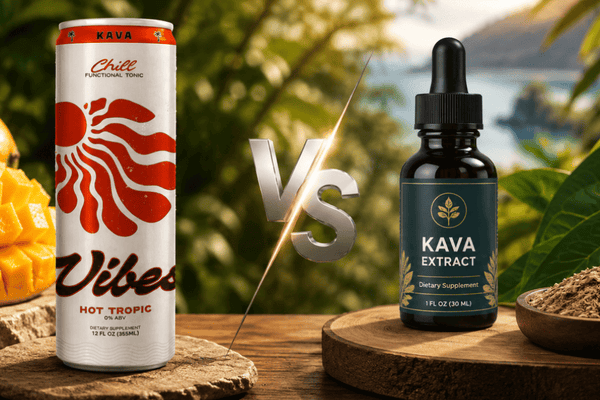
Kava Tonic vs Kava Powder: Which Should You Buy?
In this article

Shopping for Kava (Piper methysticum) often means choosing between two very different formats: bottled or canned ready-to-drink (RTD) Kava tonics and traditional Kava root powder that requires preparation. When comparing Kava tonic vs powder, neither option is automatically the better buy. The right choice depends on what matters most to you, including:
- Preparation time and effort
- Portability
- Product formulation
- Price per serving
- Ingredient preferences
- How much control you want over preparation
RTD products prioritize convenience, while Kava root powders offer a more traditional and hands-on format. This comparison breaks down the practical differences so you can decide which Kava format makes more sense for what you are buying.
Kava Tonic vs Kava Powder: A Quick Comparison
| Factor | Kava Tonic | Kava Powder |
| Format | Ready-to-drink beverage | Dry powder requiring preparation |
| Preparation | Minimal | Requires mixing/preparation |
| Portability | Easy to carry | Compact but needs preparation |
| Ingredients | May include added flavors or botanicals | Usually a simpler Kava format |
| Customization | Limited | More preparation control |
| Cost | May cost more per serving | May cost less in larger quantities |
| Best For | Convenience | Traditional preparation and value |
What Is A Kava Tonic?
A Kava tonic is a commercially prepared ready-to-drink (RTD) beverage made with Kava ingredients or Kava extracts. Unlike traditional Kava powder, the beverage is prepared by the manufacturer and typically comes in a bottle or can, making it a convenient option for buyers who don't want to prepare Kava themselves.
Kava tonic formulations can vary significantly from one product to another. Depending on the brand and recipe, a tonic may contain:
- Still or carbonated water
- Kava extract
- Natural or added flavors
- Sweeteners
- Fruit juice or other fruit ingredients
- Additional botanical ingredients
To better understand how botanicals and other functional ingredients are used in ready-to-drink beverages, explore this guide on how functional drinks work.
What Is Kava Powder?
Kava powder is a dry product made from processed parts of the Kava (Piper methysticum) plant, particularly the root and other traditionally used underground portions. Unlike a ready-to-drink tonic, traditional Kava root powder is not sold as a finished beverage and generally requires preparation before serving.
Traditional Kava preparation commonly involves combining the powder with water, working the mixture according to the product’s preparation instructions, and separating the liquid from the remaining plant material. Preparation methods can vary depending on the powder's type and processing, so buyers should always follow the directions provided with the specific product.
Kava powders can also differ in characteristics such as:
- Plant material used
- Country or region of origin
- Processing method
- Grind or particle size
- Kavalactone information
- Package size and number of servings
Compared with an RTD tonic, Kava powder gives the buyer more involvement in the preparation process and is commonly available in larger packages, which can also affect its overall cost per serving.
What’s The Difference Between Kava Tonic and Traditional Kava Powder?
The key difference between Kava tonic and traditional Kava powder comes down to preparation, convenience, ingredients, and how much control buyers have over the final beverage. While both formats contain Kava, they serve different preferences and purchasing needs.
1. Preparation
Kava Tonic
Kava tonics are designed as a convenient beverage option because the preparation process is completed before purchase. They are typically packaged as ready-to-drink products that require minimal effort before serving.
Key preparation features include:
- Comes pre-mixed and ready to serve
- Does not require measuring or mixing ingredients
- Usually requires only following the product’s serving instructions
- Provides a consistent format from one package to another
- Suitable for buyers who prefer a simpler beverage preparation process
Kava Root Powder
Kava root powder follows a more traditional preparation approach. Because it is sold in a dry format, buyers must prepare the beverage before drinking.
Key preparation features include:
- Requires mixing with water according to product directions
- Involves additional preparation time compared with RTD products
- May require separating plant material after preparation
- Allows buyers to prepare the beverage themselves
- Follows a more traditional Kava preparation method
2. Portability
Kava Tonic
Because Kava tonics are packaged as individual beverages, they are designed for easy storage and transport.
Key portability features include:
- Comes in ready-to-use bottles or cans
- Does not require separate preparation ingredients
- Convenient for travel or situations where preparation tools are unavailable
- Provides pre-packaged servings
- Takes up more physical space because each serving includes liquid packaging
Kava Root Powder
Kava powder is sold as a dry product, which can make it more compact, especially when purchased in larger quantities.
Key portability features include:
- Lightweight compared with carrying multiple RTD beverages
- Available in larger packages with multiple servings
- Requires access to water for preparation
- May require preparation tools depending on the product instructions
- Better suited for buyers who plan to prepare Kava in a specific location
3. Ingredient List
Kava Tonic
The ingredient list of a Kava tonic can vary significantly depending on the manufacturer and product formula. Since it is a finished beverage, it may contain ingredients beyond Kava.
Common ingredients may include:
- Kava extract or Kava-derived ingredients
- Water or carbonated water
- Natural flavors
- Sweeteners
- Fruit ingredients
- Other botanical ingredients
Buyers should review the product label because each ready-to-drink Kava beverage may have a different formulation.
Kava Root Powder
Traditional Kava root powder generally has a simpler product format because it is sold as processed plant material rather than a prepared beverage.
Product details may vary based on:
- Kava plant variety
- Region of origin
- Processing method
- Grind size
- Manufacturer specifications
- Available product information
Checking product details helps buyers understand exactly what they are purchasing.
4. Product Formulation
Kava Tonic
Kava tonics are finished beverages that commonly use Kava extract or other Kava-derived ingredients as part of a pre-formulated drink.
Common formulation features include:
- Uses a prepared liquid beverage base
- May contain Kava extract rather than ground plant material
- Ingredient ratios are determined by the manufacturer
- Sold in a finished, ready-to-drink format
Kava Root Powder
Kava root powder is sold as processed plant material rather than as a finished beverage.
Common characteristics include:
- Made from ground Kava plant material
- Does not include a pre-mixed beverage base
- Requires preparation before serving
- Final preparation is completed by the buyer
Research comparing different Kava preparations also shows that processing and extraction methods can influence their chemical composition, making formulation a more meaningful comparison than simply whether Kavalactones are present.
5. Customization
Kava Tonic
Ready-to-drink Kava beverages offer a more fixed format because the manufacturer determines the final formulation.
Customization features include:
- Pre-selected flavor profile
- Fixed ingredient combination
- Ready-to-serve format
- Consistent serving size
- Limited ability to adjust the beverage
Kava Root Powder
Kava root powder provides more flexibility because buyers prepare the beverage themselves.
Customization features include:
- Ability to follow preferred preparation methods
- More control over the preparation process
- Option to adjust how the beverage is prepared according to product instructions
- Ability to choose package sizes based on purchasing needs
- Traditional preparation experience
Ready-to-drink botanical beverages often involve a strict production process, including formulation, ingredient blending, and packaging. Understanding how these beverages are developed can help buyers better compare prepared formats with traditional powdered products.
Want to get more creative with Kava powder? You can use it in different homemade drinks, including smoothies, teas, coolers, and mocktail-style beverages. Check out these Kava drink recipes for more ideas.
Kava Tonic vs Powder: Cost Per Serving Comparison
Price is an important factor when comparing Kava tonic vs powder, but the lowest upfront price does not always represent the best overall value. Buyers should consider cost per serving, preparation time, convenience, packaging, and how much control they want over preparation.
A simple way to compare value is:
Package Price ÷ Number of Servings = Approximate Cost Per Serving
This calculation helps buyers understand the actual price of each serving rather than only looking at the total package cost.
| Comparison Factor | Kava Tonic | Kava Root Powder |
| Package Price | Often higher due to individual packaging and ready-to-drink format | Often lower when purchased in larger quantities |
| Serving Format | Pre-portioned beverage | Powder requiring preparation |
| Cost Per Serving | May be higher due to preparation and packaging | Often lower depending on package size |
| Preparation Time | Minimal — ready to serve | Requires additional preparation steps |
| Convenience Value | Higher for buyers who prefer a prepared option | Lower due to preparation requirements |
| Best For | Buyers prioritizing convenience and portability | Buyers prioritizing quantity and preparation control |
Ready-to-drink (RTD) Kava beverages often include additional costs for packaging, processing, and the convenience of a prepared product. This can make the price per serving higher compared with bulk Kava root powder.
However, Kava powder may cost less per serving, especially when purchased in larger quantities. Buyers should also consider the additional preparation time and equipment required.
The choice between a ready-to-drink Kava tonic and a powdered product also reflects a broader difference between RTD and powder functional drinks. RTD options prioritize convenience and a finished formulation, while powders generally give buyers more flexibility during preparation.
For a broader comparison of these two formats, see this guide to RTD vs powder functional drinks.
Is Kava Tonic As Strong As Kava Powder?
Comparing Kava tonic vs powder based only on strength can be difficult because these products come in different formats and follow different preparation methods. The final profile of a Kava product can vary depending on several factors, including formulation and preparation style.
- Product formulation: Different Kava products may have different specifications depending on how they are prepared and packaged
- Preparation method: Kava product preparation can vary based on the amount of powder used, water ratio, and preparation technique.
- Format differences: Kava tonic and Kava root powder are different product formats, making direct comparisons difficult
- Standardized packaging: Ready-to-drink (RTD) Kava beverages are typically prepared in a consistent packaged format, with product details provided by the manufacturer
When comparing Kava tonic vs powder, buyers should review product information, including Kavalactone content where available, rather than comparing formats alone. Reviewing listed specifications can help clarify how different Kava products compare.
Which Should You Buy: Kava Tonic or Powder?
For buyers exploring Kava tonic vs powder, the better option depends on how much preparation, convenience, and flexibility they prefer. Because these two formats offer different approaches, no single choice works best for everyone.
Kava Tonic May Be Better For Buyers Who Prefer
- Ready-made beverages: Kava tonic offers a prepared beverage format, making it a convenient option for buyers who don't want to prepare Kava from powder.
- Simple preparation: Because the product is already packaged as a ready-to-drink (RTD) beverage, it removes the extra steps involved in traditional Kava preparation.
- Portable options: Bottled or canned Kava tonics are easier to carry, making them suitable for buyers looking for a convenient format outside the home.
- Consistent format: RTD products are packaged in a standardized format, allowing buyers to review product details directly from the label or manufacturer information.
Kava Powder May Be Better For Buyers Who Prefer
- Traditional preparation: Kava root powder follows a more traditional format and allows buyers to prepare the beverage themselves.
- More control over preparation: Powder gives buyers greater flexibility over factors such as preparation method and the amount of powder prepared according to product instructions.
- Buying larger quantities: Kava powder is commonly available in larger packages, which may appeal to buyers comparing long-term value and cost per serving.
- A hands-on preparation process: Some buyers may prefer the traditional approach of preparing Kava rather than choosing a pre-made beverage.
For buyers looking for the simplest introduction to Kava formats, ready-to-drink Kava tonic is generally the simpler option because it requires fewer preparation steps. Buyers who prefer traditional methods, larger quantities, and more control over preparation may find Kava root powder a better fit.
FAQs
1. Can You Make Kava Drinks From Powder?
Yes. Kava powder can be prepared into a drink by combining it with water and following the preparation instructions provided with the specific product. Traditional preparation may also involve separating the liquid from the remaining plant material before serving.
2. How Long Does Kava Powder Last?
How long Kava powder lasts depends on factors such as the product's packaging, storage conditions, and the manufacturer's recommended shelf life. Check the package for the expiration or best-by date, and follow the manufacturer's storage instructions.
For more information about Kava duration and how long different Kava formats may last, see this guide on how long Kava lasts.
3. Does Kava Powder Dissolve in Water?
Traditional Kava powder does not necessarily dissolve completely in water like an instant beverage powder. Preparation can involve mixing the powder with water and separating the liquid from the remaining plant material. Preparation methods vary by product, so follow the manufacturer's instructions.
4. What Should You Look for When Buying Kava Powder?
When buying Kava powder, consider details such as the plant material used, country or region of origin, processing method, grind size, available Kavalactone information, and package size. Checking these details can help you understand the product and compare different Kava powders.
5. What Should You Check on a Kava Tonic Label?
Check the ingredient list and product information before buying a Kava tonic. Depending on the product, the label may list Kava extract or other Kava-derived ingredients alongside water, flavors, sweeteners, fruit ingredients, or additional botanicals. Product formulations can vary between brands, so reviewing the label helps you know exactly what is included.
6. Can Kava Powder and Kava Tonic Have Different Ingredients?
Yes. Kava powder and Kava tonic can have different ingredient profiles because they are sold in different formats. Traditional Kava powder is generally processed plant material, while a ready-to-drink Kava tonic may contain Kava extract along with ingredients such as water, flavors, sweeteners, fruit ingredients, or other botanicals. Always check the specific product label for the complete ingredient list.
7. Kava Tonic or Powder: Which Is Better For Beginners?
For buyers who prefer a simple introduction to Kava formats, ready-to-drink Kava tonic is generally the more straightforward option because it requires fewer preparation steps. Buyers who prefer traditional preparation and more control may prefer Kava root powder.
8. Is Kava Powder Cheaper Than Tonic?
Kava powder is often less expensive per serving, particularly when purchased in larger quantities. Kava tonic may cost more per serving because the price can include processing, individual packaging, and the convenience of a ready-to-drink format.
9. Which Is Easier To Use, Kava Tonic or Powder?
Kava tonic is generally easier to use because it comes as a ready-to-drink beverage and requires minimal preparation. Kava powder requires additional steps, such as mixing with water and potentially separating the liquid from the plant material. The choice ultimately depends on whether you prefer convenience or a more hands-on preparation process.
Disclaimer:
This article is for informational purposes only and is intended to help readers compare Kava tonic and Kava powder formats. Kava products can vary in ingredients, formulation, processing, and labeling, so always review the product information and follow the manufacturer's instructions. This information is not intended to provide medical advice or replace guidance from a qualified healthcare professional.